

Alexandra Masgras reviews the exhibition Garden Futures: Designing with Nature on display at the V&A Dundee, Scotland
The field of design has long evinced a self-reflexive relationship to the realm of non-human life conceptualized as “nature.” From the development of biomorphic form in response to the incipient industrialization of the crafts in the mid-nineteenth century to contemporary “eco-friendly” objects designed to sustain complex biotopes, designers have espoused a range of positions toward the transformation of nature by human agency. As objects of design, gardens occupy an ambivalent—and therefore highly generative—role in this history of encounters with nature. The globe-spanning historical genealogy of gardens and the speculative futures they have inspired are the subject of the exhibition Garden Futures: Designing with Nature, on display at the Victoria & Albert Museum in Dundee, Scotland until January 2026.
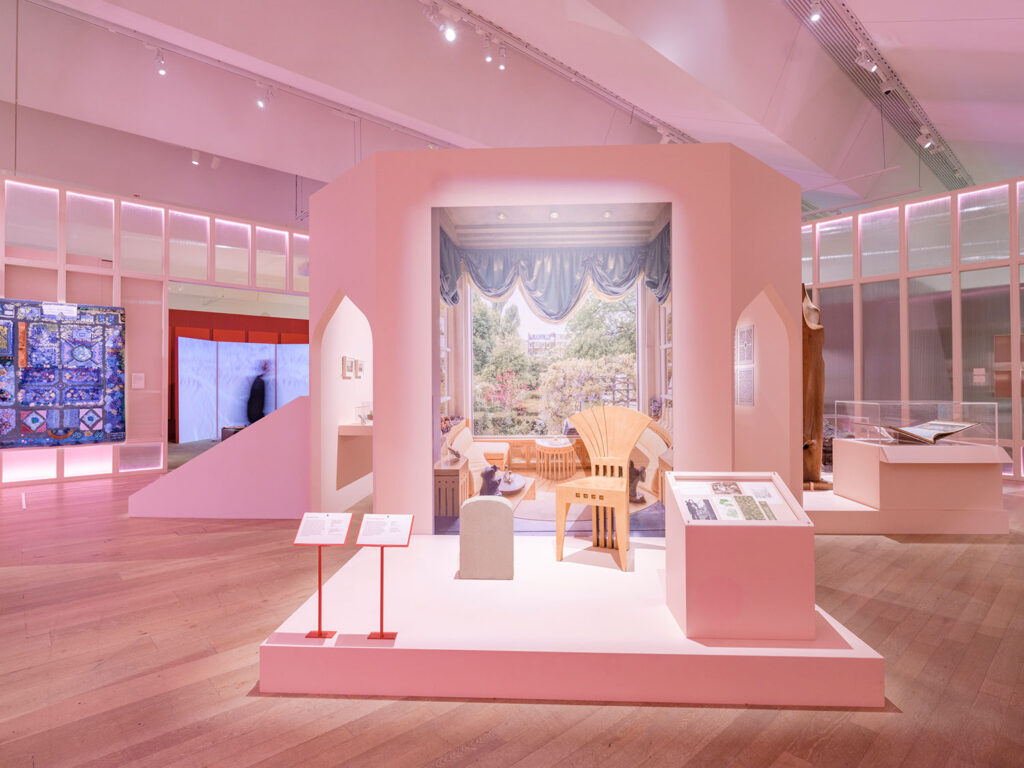
Initially conceived in 2023 by the Vitra Design Museum, the Nieuwe Instituut, and the Wüstenrot Stiftung with the financial backing of corporate sponsors, the exhibition explores ways of perceiving, imagining, and physically shaping gardens across time periods and geographical categories. Broadly speaking, the exhibition comprises a historical overview and a display of contemporary practices, which together portray gardens as multivalent sites of creativity and utopian aspirations, as well as of control and exploitation. The show’s broad subject matter not only opens up a capacious array of conceptual categories, but also invites thoughtful juxtapositions which challenge conventional binaries.
Upon entering the exhibition, the viewer is met with an array of garden furniture and tools—some familiar, others recuperated from historical collections. Given the show’s intended wide appeal, the first gallery succeeds in establishing a sense of familiarity and relevance, while also hinting at the exhibition’s aim to historicize garden design. This latter promise is taken up by the subsequent thematic galleries: the historically-grounded “Paradise” and “Garden Politics,” followed by the exploratory contemporary sections—“Testing Grounds” and “The World as a Garden.” Overall, the content of each of these galleries is diverse enough to raise generative questions instead of upholding predetermined conclusions. However, while the historical sections invite critical readings of the phenomena examined, the contemporary galleries tend to fall into the very same positivist logic which is held up for scrutiny by the previous displays.
A great merit of the exhibition lies in tracing a genealogy of gardens that account for their quasi-universal appeal. The gallery “Paradise” opens with an examination of gardens as images of heavenly harmony in Christianity and Islam. This somewhat conventional beginning then branches out to explore the various aesthetic ramifications of gardens’ ostensible perfection—or, more to the point, their perfectibility. From exploring religious connotations, the display shifts to incorporate aesthetic means of apprehending and transforming nature in eighteenth-century Britain, epitomized by picturesque viewing devices. The foray into aesthetics continues with an overview of modernist and postmodernist attempts to reestablish gardens as places of contemplation, exemplified by Barbara Hepworth’s Sculpture Garden and the Cosmic House designed by Charles and Maggie Jencks. The long-standing association between gardens and paradisiacal visions thus opens the way for a more capacious analysis of the quest for harmony and perfection, which continued long after the influence of religious patronage on cultural production faded in the eighteenth century.
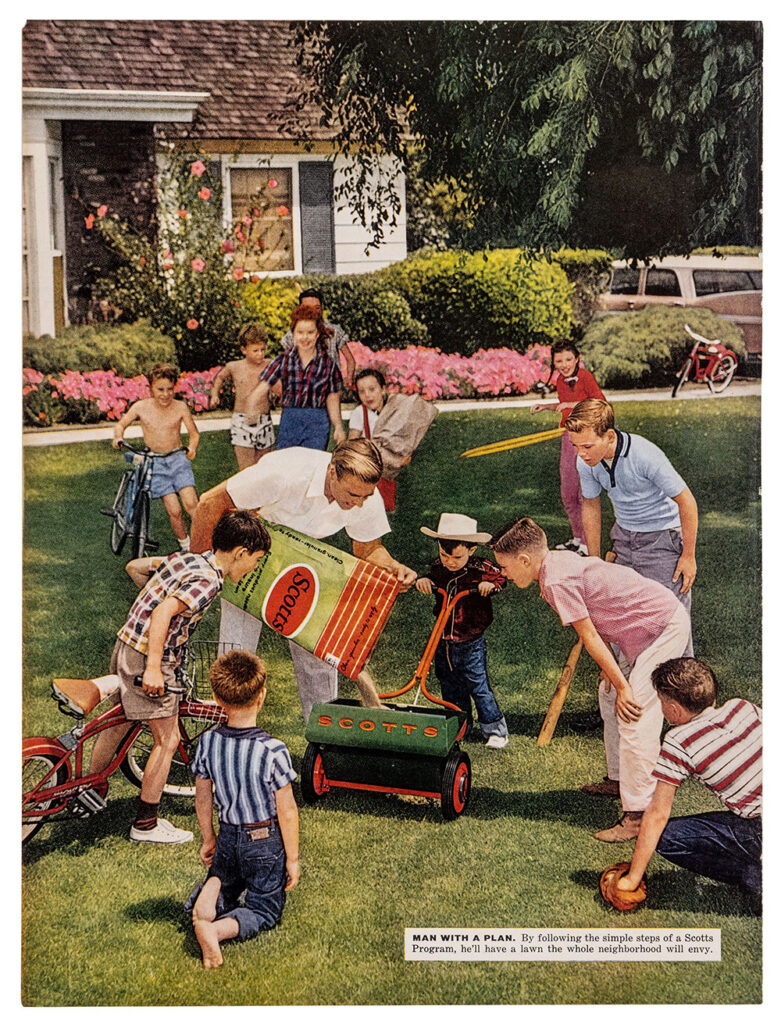
The material and political implications of these post-Enlightenment utopian strivings are parsed out in the section “Garden Politics.” This gallery is commendable for the broad array of artifacts it brings together as well as for its thematic reach. Encompassing objects such as botanical cases designed to bring native plants from the colonies home to British researchers, wartime posters promoting subsistence gardens, and mid-twentieth-century chemical fertilizer advertisements for the maintenance of perfect lawns in the suburban United States, the artefacts displayed here point to the confluence of knowledge and political, military, and economic power that have shaped our contemporary world. In light of this display, gardens appear as complex assemblages where personal ambitions, commercial interests, and state agendas reinforce each other in compelling ways. Far from the visions of paradise displayed in the first section of the exhibition, “Garden Politics” examines the multivalent role that gardens have played in envisioning new forms of social organization—from programs designed to strengthen the so-called home front in wartime to Ebenezer Howard’s panacea to the ills of industrial society, namely, the “Garden City” urban planning model. This analysis of mechanisms of power is complemented by an examination of practices of local resistance centered on gardens. The works of photojournalist Lalage Snow in Afghanistan and eastern Ukraine features as a testimony to the role that gardens play in ensuring subsistence in times of scarcity and in fostering future-oriented thinking which may bring emotional comfort. On the whole, this gallery establishes a fine balance between a judicious examination of how political and commercial interests have left an indelible imprint on the often-naturalized space of the garden, while also refraining from presenting such vectors of power as total and immutable.
The analytical nuances established in the historical section offer a helpful guide for navigating the contemporary galleries, which fall short of providing a similarly complex account. The contemporary displays are more predictable in their thematic scope, emphasizing local grassroots initiatives to combine access to green space with cultural programming, alongside several instances of romanticized artistic practice centered on the very notion of natural harmony that the gallery “Paradise” so subtly unpacks. Another vector in the shaping of the contemporary galleries is corporate sponsorship, for the major backer of the exhibition is included in the display as an exemplary sustainable business model. The show concludes with a series of design innovations pointing to the future of gardening practice. With few exceptions, the prototypes displayed here evince a belief in the power of technology to engineer nature in order to alleviate the impact of human-made climate change. Such technological optimism, reified by vertical gardens and clay-based artificial reefs for fostering marine microorganisms, takes at times sinister nuances, as in the case of a plant-growing system designed to function autonomously without human interference. Wither the humans? This approach is counterbalanced by the presentation of local initiatives which seek to interweave the preservation of plant life with human wellbeing, as in the case of Mohamed Sleiman Labat and Taleb Brahim’s sand gardens, which provide the Sahrawi communities of Western Sahara with water-saving agricultural technologies.
Despite its future-oriented title, “Garden Futures” excels at historicizing the widespread and enduring appeal of gardens. Thanks to its complexity and nuance, the exhibition’s historical preamble succeeds in questioning tropes that naturalize and depoliticize gardens as harmonious, perennial spaces. The reiteration in the contemporary display of some of the very same received ideas that the exhibition as a whole problematizes is less felicitous. Perhaps to the joy of historians, “Garden Futures” lends evidence to the truism that understanding the past is necessary for navigating a fraught present, including the one sketched out by the show’s contemporary sections
FURTHER READINGS:
- Garden Futures: Designing with Nature. Eds. Viviane Stappmanns and Mateo Kries. Weil am Rhein and Ludwigsburg, Germany: Vitra Design Museum and Wüstenrot Stiftung, 2023.
- Uncommon Ground: Toward Reinventing Nature. Ed. William Cronon. New York and London: W.W. Norton & Co., 1995.
- The Moral Authority of Nature. Eds. Lorraine Daston and Fernando Vidal. Chicago: University of Chicago Press, 2003.
- Kenny Cupers. The Earth That Modernism Built: Empire and the Rise of Planetary Design. Austin, TX: University of Austin Press, 2024.
ALEXANDRA MASGRAS is research associate in the Research Group “Kunst, Umwelt, Ökologie” at the ZI.