
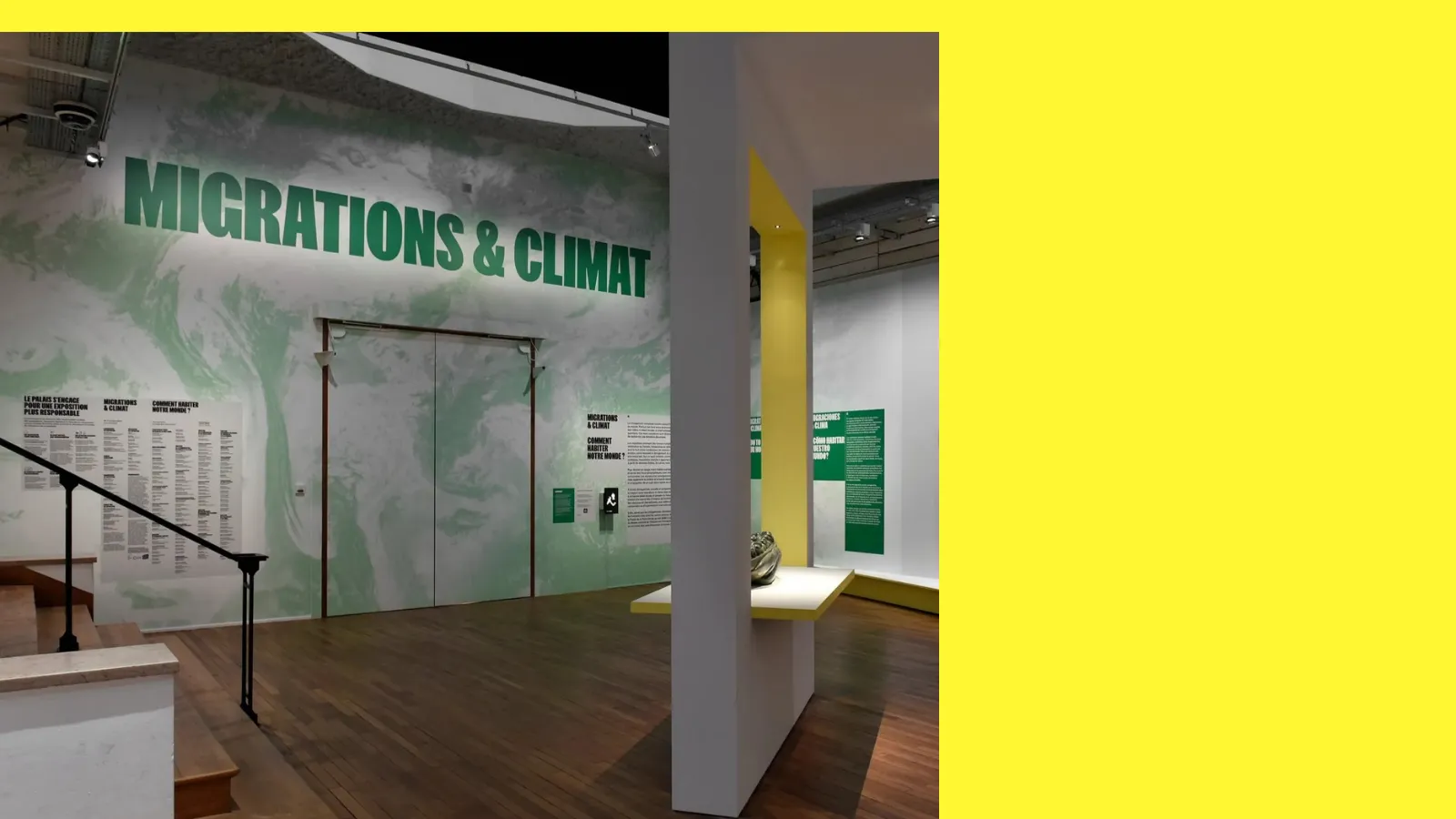
Lola Lorant reviews the exhibition Migrations and Climate on display at the Palais de la Porte Dorée, Paris (October 17, 2025 – April 5, 2026)
“There is probably no such thing as a ‘pure’ climate migrant.”1 The exhibition Migrations and Climate. How to inhabit our world?, which opened at the Palais de la Porte Dorée in Paris in October 2025 addressed this topic, in a “politically sensitive”2 way as its chief curator, Bruno Girveau, noted. The exhibition aimed to tackle societal complexity by reminding visitors that climate is just one factor, entangled with political, economic, and social crises that also drive migration. Yet, ultimately, it was precisely these political and economic drivers of climate change that the exhibition avoided.
Migrations and Climate adopts a long-term approach to its topic by gathering a heterogenous mix of cultural artefacts — including paintings, sculptures, photographs, films, children’s books, comics, archaeological objects, stuffed butterflies, and pastoral bells, thereby intertwining both human and non-human migration throughout the display. Aimed at a wide audience, the exhibition prioritized eliciting emotions and curiosity over presenting a clear, comprehensive historical approach or a strong, critical political commitment.
Upon entering the exhibition, a visitor would first encounter Shared Migration (2013) by the artist Abraham Anghik Ruben. The serpentine sculpture depicts the Scandinavian god Odin transformed into a boat-like creature sailing away with animals, spirits, and people, echoing traditional “Inuit” soapstone sculpture. It set the tone of the exhibition, framing migration as a “necessary and common destiny” 3, as stated in the catalogue. The identity of the artist, who belongs to the indigenous Inuit Mackenzie people, may have been instrumental in implying that migration is deeply rooted in the beliefs and ways of life of communities perceived as proto-environmentalist — and who are most threatened by climate change today. In this respect, one cannot help but notice that most of the selections in the introductory sections of the exhibition are drawn from traditions, religions, or myths, treating “migration” as a timeless, almost anthropological, if not universal phenomenon. Yet, have all human societies been in the same boat since the dawn of time when it comes to environmentally motivated migration?
It is indeed high time that the environment was considered part and parcel of social history, provided climate is historicized. Migrations and Climate, as its singular form implies, tends to flatten the environmental side of history, smoothing out human-induced climate change. The exhibition gathered a highly heterogenous selection of exhibits spanning various centuries: from changing hunting strategies at the end of the Ice Age to Jan Brueghel’s early 17th-century painting The Flood, and from traditional seasonal livestock migration in the Alps to modern catastrophes like the Dust Bowl in the 1930s and the 2004 tsunami in Indonesia. This mix not only creates a patchy history but risks conflating weather, natural occurrences, and anthropogenic climate change, even where connections exist. While historian John R. McNeill argues in his popular book on 20th century environmental history that there is ‘Something New Under the Sun’, a wall text in the exhibition choose to leave it as an open question.
The exhibition unfolded across both the Musée national de l’immigration (National Museum of Migration History) and the Aquarium Tropical within the Palais de la Porte Dorée. By contrast, the subsequent sections were thematic, contributing to the well-intended yet difficult task that Musée national de l’histoire de l’immigration set for itself: to shatter preconceived ideas on immigration. The exhibition then turned to contemporary topics, predominantly grappling with rising sea level or hurricanes along the Vendée coastline, in Mayotte, Louisiana, Sudan, the Mekong Delta, in the Arctic, in the Pacific Ocean and in Senegal. Maps, charts, photographs, and video documentaries didactically portrayed situations designed to inspire understanding and empathy, particularly by linking the structural issue of climate disasters back to distressing, deeply intimate individual experiences. Once again, art was called upon in this endeavor. Photographer and filmmaker Laura Henno, for instance, captures the devastation left in the wake of Cyclone Chido in December 2025, a project developed within an artistic residency supported by the Palais de la Porte Dorée. In fact, acquiring art as a tool to shift perspectives on migration has been central to the institution’s mission since its inception in 2004. Here, documentary photography takes center stage, oscillating between sobriety and a sensationalism from which it is difficult to distance oneself. Furthermore, commissioning diverse content produced by those directly affected has become a common strategy to reshape representations of migration and demonstrate the institution’s political sensitivity. A documentary video directed by the NGO TIDE (Talent Initiative for Development) and produced specifically for the exhibition gathers down-to-earth testimonies from environmental refugees displaced in a Mangalla camp, showing them struggling on a daily basis to meet their most basic needs at every stage of their migratory path in South Sudan. While the video highlights initiatives that use art for education purposes, it crucially departs from the spectacular to focus on the raw reality of their ordeal.
The efficacy of art as a tool to raise awareness can be questioned in any attempt to address climate change. Reservations grow even stronger when art fantasizes about environmental migration by righteously promoting its acceptance. In this regard, the large installation Crochet Coral Reef by Christine and Margaret Wertheim is indeed mesmerizing. Its swarming colorful polyps and tentacles crafted in yarn — the result of a highly collaborative process — mimic growing, buoyant corals in full bloom. This aesthetic conjures up optimism by eluding the undergoing loss of those organisms. While the catalogue commentary hints at the bleaching and extinction of corals, it also mentions the migration of larvae to cooler waters as a possible strategy for survival. Displayed within Migrations and Climate, an exhibition that insists on presenting environmental migration as an inescapable form of adaptation for non-humans and humans alike, the installation suggests that displacement might, at the same time, be the solution. As the exhibition touches upon how to face global warming in its last sections, the Antarctica World Passport Office designed by the artists Lucy + Jorge Orta builds upon a DIY aesthetics to envision a utopian, peaceful, and borderless world. Yet, such beautiful metaphors for a future characterized by growing environmental threats may ultimately equate to political resignation.
The surrender is all the more awkward as the historical and political causes of our current climate crises are hardly targeted, being only briefly mentioned in the catalogue. The global history of capitalist extraction is silenced in an exhibition housed within in the Palais de la Porte Dorée — a venue specifically built for the International Colonial Exhibition of 1931. Symptomatic of depoliticized decolonial discourses, Migrations and Climate becomes remarkably timid when it comes to consider the overarching dynamics and crises of capitalism involved in climate change. To be fair, the exhibition does showcase diverse situations demonstrating how our environmental crisis unequally affects people throughout the world. In this regard, it symbolically decriminalizes migration in a context of rising xenophobic discourses in France. At the same time, existing legal boundaries to migration are sidestepped while climate change is depoliticized.
Lola Lorant holds a PhD in Contemporary Art History and teaches at Université Rennes 2. She joined the research group “Umwelt und Ökologie” at the ZI in November 2026 with the support of a research scholarship by the DAAD. Her work examines the exhibition Villette-Amazone at the intersection of art and the promotion of sustainable development in the 1990s.
- Franck Adoho and Quentin Wodon, “Do Changes in Weather Patterns and the Environment Lead to Migration?” in Quentin Wodon, Andrea Liverani, George Joseph, and Nathalie Bougnoux (eds), Climate Change and Migration: Evidence from the Middle East and North Africa, Washington D.C., The World Bank, 2014, p. 146. ↩︎
- Bruno Girveau «Entends-tu hurler nos glaciers sous l’effet du réchauffement climatique ? » in Bruno Girveau, Élizabeth Jolys Shimells and Gabriel Picot (eds), Migrations & Climat. Comment habiter notre monde?, exhibition catalogue, Milan, Silvana Editoriale; Paris, Palais de la Porte Dorée, p. 13. ↩︎
- Ibidem, p. 30. ↩︎
FURTHER READINGS
- Bellamy Foster, John, Brett Clark and Richard York, The Ecological Rift. Capitalism War on the Earth, New York, Monthly Review Press, 2010.
- Bonneuil, Christophe and Jean-Baptiste Fressoz, L’événement Anthropocène : La Terre, l’histoire et nous [2013], Paris, Éditions du Seuil, 2016.
- Harribey, Jean-Marie and Michael Löwy, Capital contre nature, Paris, PUF, 2003.
- Moore, Jason (ed), Anthropocene or Capitalocene?: Nature, history, and the crisis of capitalism, Oakland, PM Press, 2016.
DIESE BEITRÄGE KÖNNTEN SIE AUCH INTERESSIEREN:
Under the guise of destiny: Migrations and Climate
Lola Lorant reviews the exhibition Migrations and Climate on display at the Palais de la Porte Dorée, Paris (October 17, 2025 – April 5, 2026) “There is probably no such thing as a ‘pure’ climate migrant.”1 The exhibition Migrations and Climate….
„Don’t cry over spilt milk“ – Von den Resten einer geplanten Zukunft
Friederike Schäfer on the 61st La Biennale di Venezia 2026
Reflections on the Undercurrents of the Large-scale International Art Exhibition The curatorial statement for the 61st Venice Biennale (9 May to 22 November 2026) opens with an invitation: “[Take a deep breath] [Exhale] [Drop your shoulders] [Close your eyes]” (Kouoh, Part…

Im Peniswald
Das Bücherbeet. Künstlerisch-kuratorische Essays zu Kunst und Ökologie
Schreibe einen Kommentar