
Friederike Schäfer on the 61st
La Biennale di Venezia 2026
The curatorial statement for the 61st Venice Biennale (9 May to 22 November 2026) opens with an invitation: “[Take a deep breath] [Exhale] [Drop your shoulders] [Close your eyes]” (Kouoh, Part I). With this brief somatic exercise, the late curator Koyo Kouoh introduced her theme In Minor Keys. At first glance, this instruction to shift attention from external stimuli towards introspection seems counterintuitive for a large-scale biennial, whose very format thrives on an abundance of aesthetic experiences elicited through various exhibitions that only together converge to La Biennale. Alongside the curated exhibition In Minor Keys, with its 110 invited participants, and the 100 official national participations (seven of them for the first time), this further includes 31 collateral, as well as numerous off-the-record events. Yet, rather than proposing a retreat from the world, Kouoh stated that she sought to establish a different mode of attention. Taken from the realm of musical theory, In Minor Keys alludes to the correlation between structure and emotion inherent within sound. To her, the resonating and ambient quality of this tonality that encompasses both tragedy and hope connects the sphere of the metaphorical to literal/physical realities. The exhibition seeks to sharpen the senses to enable the visitors to “tune in to the frequencies of the minor keys” within “the immediate physical, meteorological, ambient and karmic conditions” that they are situated in (Kouoh, Part I). Kouoh therewith calls for nothing less than a reorientation in how visitors should approach the art assembled in the exhibition, based on the involvement of all senses to overcome the primacy of vision. The question is what curatorial means have been applied to facilitate this shift of aesthetic experience, and whether La Biennale provides an apt environment for this introspection to take place.
According to the curatorial concept, this approach is not to be understood as a contemplative or solely sentimental gesture, despite its focus on emotional effects. For it does not ask the visitors to close their eyes to the major issues of this world—which are visible and audible, loud and clear at this Biennale, more than ever before. For the overall environmental conditions are shaped through past actions and politics. Her goal is to engage the entire body and to enable the visitor to connect this experience to the larger context. Yet, how can these lower frequencies compete with the high-pitched sounds of the spectacle inherent to the biennale format? How can “the minor” outbalance “the mega”? And what is the resonance of the minor keys throughout the La Biennale—also within the visitors themselves?
The Structure of the Exhibition
Today, La Biennale is a “large-scale show of exhibitions,” hosting all sorts of art presentations, including multiple exhibitions and ephemeral events, such as performances, film screenings, talks, or book launches, all competing for attention. Its specific structure poses a challenge for the invited curators, as they are asked to conceive a curatorial concept that both provides a common theme and a distinct exhibition. Furthermore, as contemporary art operates with various imageries, idiosyncratic symbolisms, and eclectic references, the specific aesthetic experience of traversing through the different exhibitions of La Biennale challenges visitors to pick up the latent frequencies of the minor keys in order to draw connections despite the often-disparate aesthetics. In this regard, the conception runs the risk of going under within the exuberant Giardini or of fading out in the défilé through the Arsenale. And yet, one can detect distinguishable “undercurrents” that emanate from the “minor keys” at the central exhibition and resonate or reemerge in various forms. For example, one could follow the theme of the “current,” respectively water, itself—specifically through the relations between bodies and water—including at Florentina Holzinger’s predominant Seaworld Venice at the Austrian Pavilion (Brabant 2026 >>), or the technospheric recreation of an imperial water lily pond at the Canadian Pavilion by Abbas Akhavan (Entre chien et loup).
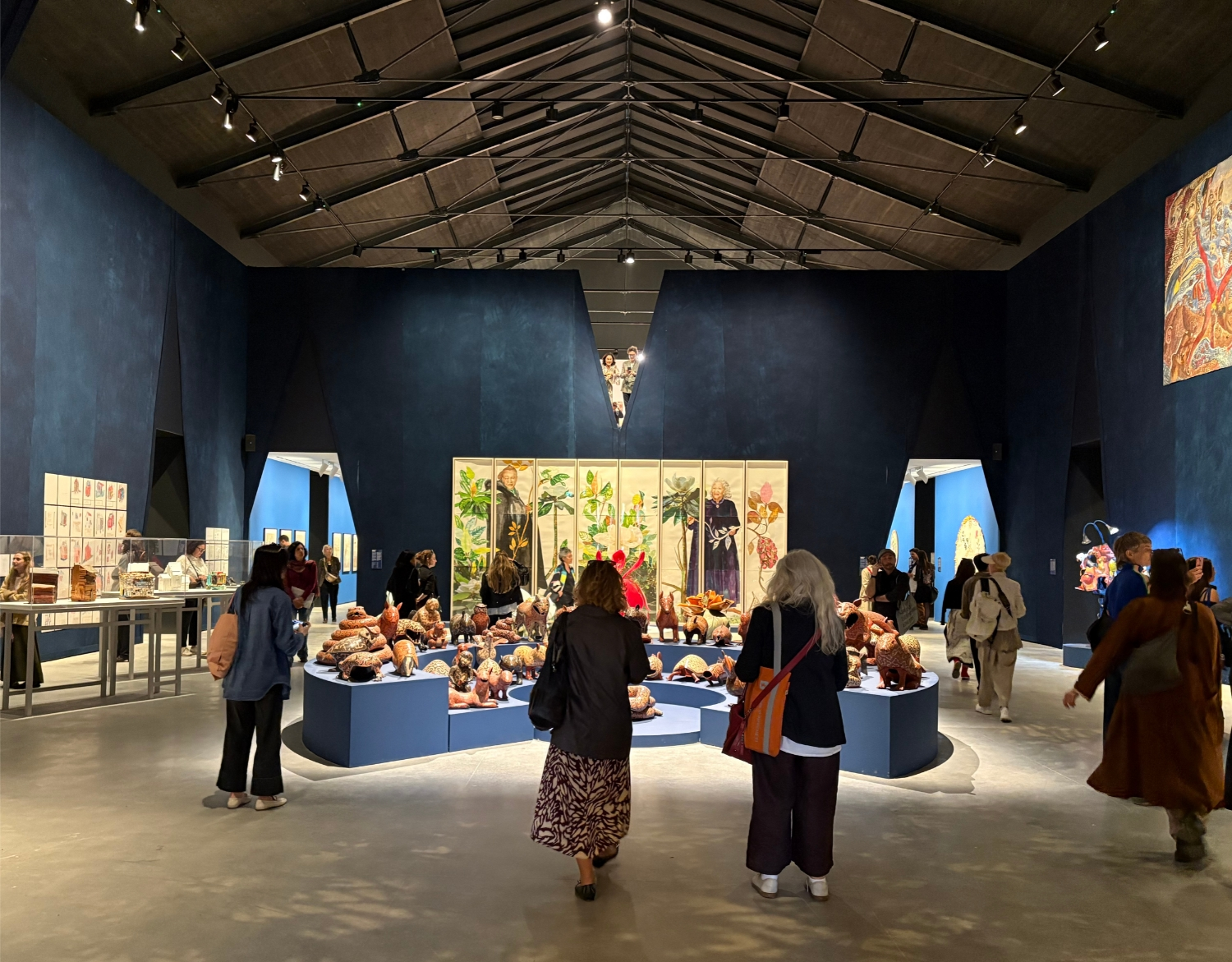
The notion of the current also represents Kouoh’s processual approach to exhibition-making, which was then carried out by her confidant curatorial team, after her sudden death in 2025. La Squadra di Koyo (Gabe Beckhurst Feijoo, Marie Hélène Pereira, Rasha Salti, Siddhartha Mitter, and Rory Tsapayi) developed the exhibition along what they describe as “undercurrent priorities” (La Squadra di Koyo, Part II). Accordingly, the structure rather resembles a composition with recurring themes and resonating echoes than providing clear sections or chapters. The current is not a mere metaphor, and has also manifested in the general design: Throughout the central pavilion itself, the ocean blue of deep waters has literally spilled into the newly renovated gallery spaces, and serves as the primary background for the overall display.
Within the visitors’ course through the exhibition with its 110 invited artists, collaborative duos, collectives and artist-led organizations, the overall experience, however, converges with the 100 “national” exhibitions at the Venice Biennale. While the curated exhibition In Minor Keys spans across the two main venues of the Giardini and the Arsenale, the “national participations” compete for attention, each with their own exhibitions. In addition to the 29 national pavilions built at the historic biennale site of the Giardini and 25 national representations positioned at the Arsenale, all succeeding nations that made it onto the list have to find individual niches within the Venetian Lagoon. Even without eruptive, but short-lived protests, or the scheduled performances and accompanying events during the opening days, this large-scale exhibition generally does not allow the visitor to “close their eyes” or to “take a deep breath.”
With any exhibition system that is thusly orotund and pompous, there is plenty to critique; for example regarding the overtly friendly attitude of the curatorial team towards the highly controversial Biennale president Pietrangelo Buttafuoco. By reinviting Russia and Israel, he in effect instrumentalized art while claiming to do exactly the opposite. By stating that the art space can serve as a neutral ground where the “world comes together,” he negates its political undercurrents and entanglement with real world conflicts. This stands in contrast to the curatorial concept that sought to address these very issues, including through an inherent critique of the art system.
The Currents of the Exhibition
The echoes of institutional critique resonate throughout the exhibition, for example in Kouoh’s key conceptual thread of “Schools” and in the short texts accompanying the artworks. Yet, neither the representation of six “independent” artist-led initiatives nor the inclusion of various other social and performative practices counter the dilemma that the very structure of an exhibition inherently turns every thing placed within the display into an artwork, predominantly recognized through the act of viewing. Consequently, the elaborate costume with colorful feathers and beaded imagery by Big Chief Demond Melancon (of the Young Seminole Hunter tribe) appears as a figurative sculpture that relies on the visitors’ imagination of a live performance. With the display of performative and social practices and devotional objects, such as in the form of “Shrines,” Kouoh seeks to address the capability of artists to make other worlds and to conjure new universes.
Yet, a large part of the so-called international art world that gathers in Venice every second year, occupies a sphere and mindset different from those on display. The reality of the biennale’s inner workings at large clashes with the pronounced curatorial ideals of conviviality, community and care—despite an ongoing international art discourse that draws on these very concepts. Many visitors, who have moved quite comfortably within the international art scene in the past, still struggle when they encounter unfamiliar worldviews views or even entirely different worlds. The exhibition enhances this encounter as a physical experience through an overabundance of materials and encompassing installations in combination with specific symbolisms: Plush, glitter and glint are applied generously without tongue-in-cheek, such as in the ostentatious assemblage when the land is in plumage… (2020) by Ebony G. Patterson, as well as earthen materials and mythological imageries, without the apprehension of being deemed craftwork or archaic. Shades of raw and fired clay are present in various forms and traditions of pottery, exhibiting its quality of being both strong and fragile. For example, the arrangement of ceramic zoomorphic sculptures titled The Council of the Mother Spirits of the Animals by Peruvian/Shipibo-Conibo artist and activist Celia Vásquez Yui physically confronts the incoming visitors.
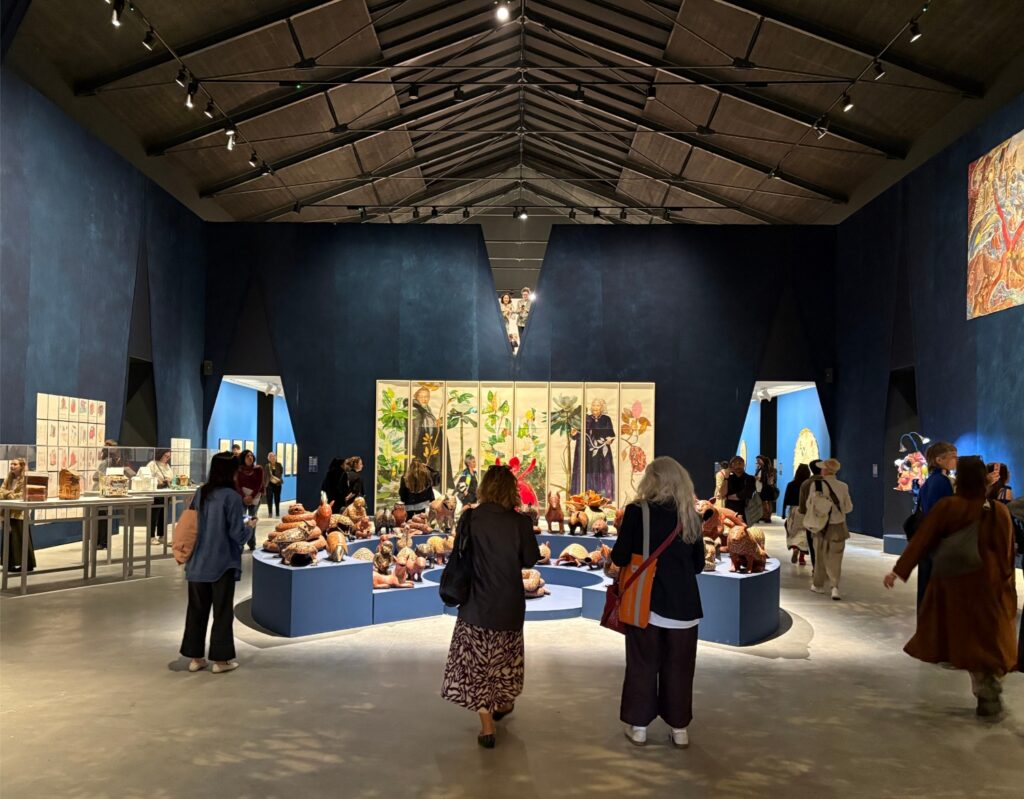
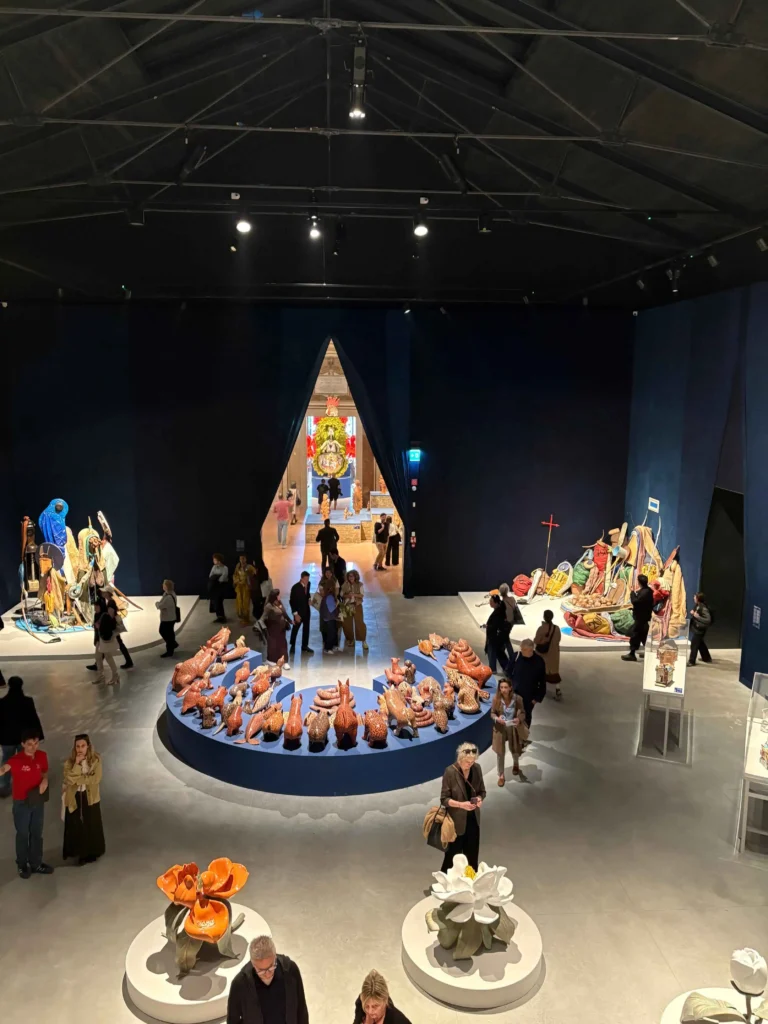
By drawing on the vexed category of “beauty” as one shared premise of art making, Kouoh demonstrates that she is not afraid to cross its fine line with the copiousness of color, form and materiality that could be regarded as kitsch. The monumental glass flowers by Cuban-born artist María Magdalena Campos-Pons, which provide the ground for a multi-panel double portrait in her installation Anatomy of the Magnolia Tree for Koyo Kouoh and Toni Morrison (2026), do not grow out of the slick kitsch-aesthetics of the “materialist” agenda of Jeff Koons, but on the artisan tradition of Venetian glassmaking and the principle of the self-sustaining Creole garden. In a similar vein, the eclectic sculptures, which Afro-Puerto Rican artist Daniel Lind-Ramos assembled from found and gifted objects, no longer rely on the Duchampian objet trouvé. The series Telegas de la memoria II (2023–2024) is made out of material washed ashore after a hurricane and references the escape of slaves through waterscapes. The exhibition therewith demands engagement with a plethora of references and histories that remain underrepresented in most prestigious art collections worldwide, as well as with diverse poetics—for unfamiliar sounds do not necessarily find resonance within everybody.
The Exhibition Experience
The act of attunement is also required for orienting oneself, as the display does not provide a super-structure, sorting “positions” into categories or signaling a clear route for the grand tour. At the Arsenale, the overflow of sensual input is emphasized by the architectonic structure of the historic Corderie (rope-walk). The longitudinal space turns the walk into a seemingly endless succession of works, in which visitors can lose their sense for time and space—and their breath.
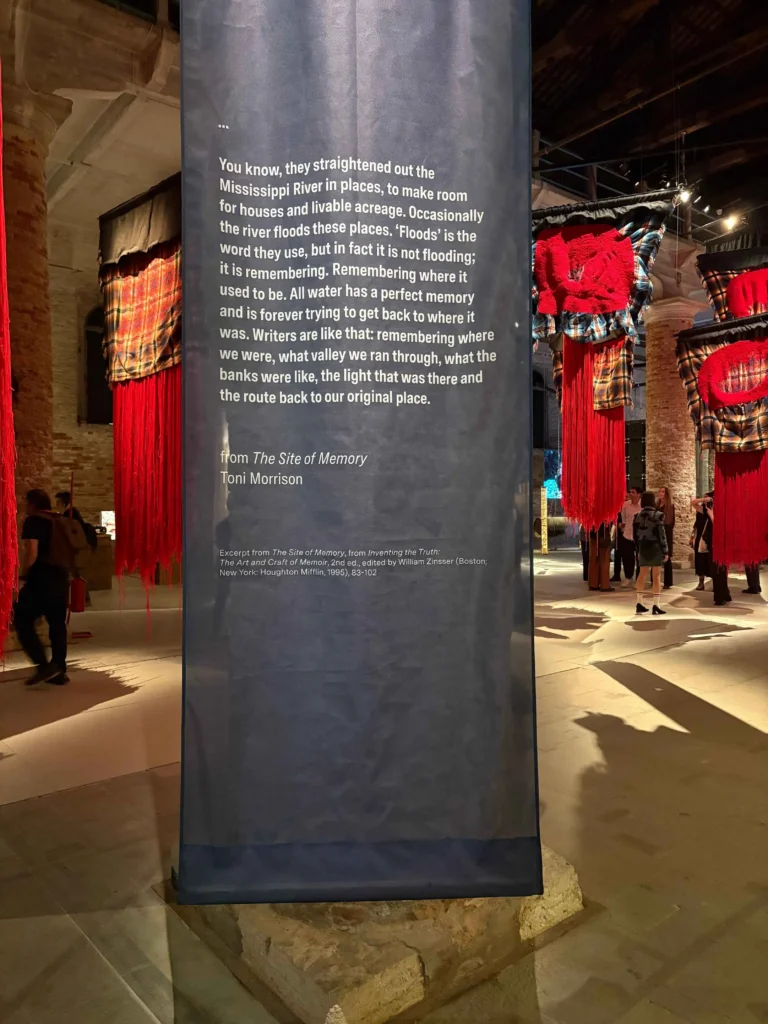
Fig. 3: Installation view of the international exhibition In Minor Keys, Corderie dell’Arsenale. Printed banner with text by Toni Morrison | Photo: Friederike Schäfer
Long banners of blue fabric interrupt the continuous forward motion with texts by writers and poets, including Toni Morrison and Ben Okri. They are placed to provide connecting points to the curatorial framework as well as for an intermission, but remain elusive; a line from a poem by Etel Adnan fittingly reads “I sense space’s elasticity.” Yet, the creation of spaces to pause was not only evoked through the initial awareness practice, but was incorporated within the architecture of the exhibition, as well—especially at the newly renovated central pavilion, which now includes a terrace with water view. The discussions during the opening, however, made it clear that visitors struggled to follow this idea of the fluid display, structured by moments of an introspective repose against the current of the inbuilt patterns of perception of conventional exhibitions. Conceived for the Biennale format, In Minor Keys both caters to and challenges the eye trained on the aesthetics of a Western canon. Yet, this experience of instability and clashing aesthetics can turn into an informative and enriching experience, as one navigates through the many artistic universes that at times coalesce and other times collide within this expansive spatio-temporal setting.
DR. FRIEDERIKE SCHÄFER is an art historian and holds the position of academic associate and deputy head of the Archive and Collections at the Berlin-Brandenburg Academy of Sciences and Humanities. She is the co‑founder of the working group Exhibition Ecologies.
LITERATURE
Dominik Brabant: Akte in Venedig: Dominik Brabant über Florentina Holzingers Beitrag für den Österreichischen Pavillon auf der diesjährigen Biennale. In: ZI Blog, June 17, 2026, https://www.zispotlight.de/akte-in-venedig-dominik-brabant-florentina-holzinger-biennale/.
James Imam: ‘Exclusion can only satisfy the ego’: Venice Biennale president hits out at critics amid Russia and Israel controversy. In: The Art Newspaper, May 9 2026. https://www.theartnewspaper.com/2026/05/07/exclusion-can-only-satisfy-the-ego-venice-biennale-president-hits-out-at-critics-amid-russia-and-israel-controversy
Koyo Kouoh: In Minor Keys: Part I, La Biennale di Venezia: 61st International Art Exhibition, 2026.
La Biennale di Venezia. 61st International Art Exhibition, Press release, 2026. https://www.labiennale.org/en/news/biennale-arte-2026-minor-keys-0
La squadra di Koyo Kouoh. In Minor Keys: Part II, La Biennale di Venezia: 61st International Art Exhibition, 2026.
Im Peniswald
Das Bücherbeet. Künstlerisch-kuratorische Essays zu Kunst und Ökologie
Das Bücherbeet. Künstlerisch-kuratorische Essays zu Kunst und Ökologie
Seit März 2025 wird eine Vitrine im ZI als eine Art Hochbeet von Nanne Buurman…
Das Bücherbeet. Künstlerisch-kuratorische Essays zu Kunst und Ökologie
Seit März 2025 wird eine Vitrine im ZI als eine Art Hochbeet von Nanne Buurman…
Schreibe einen Kommentar